
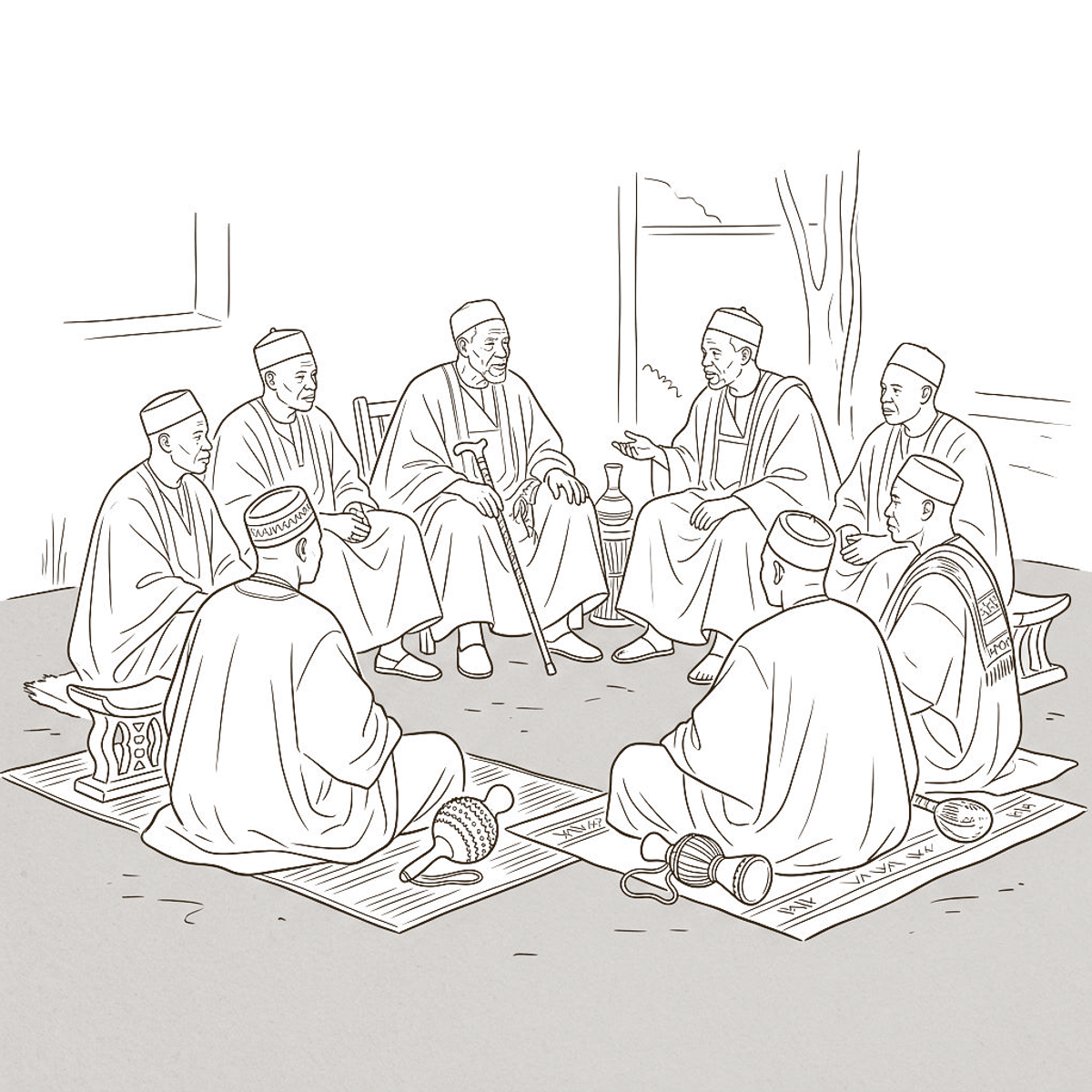
In Aneho, an individual's identity is not defined by a simple surname, but by their belonging to an Akangban (the clan). As the true matrix of Guin society, this kinship system dictates the rules of solidarity, spiritual duties, and the political organization of the entire community.
Origins of the Akangban
The term "Akangban" refers to the extended lineage, a group of individuals claiming descent from the same mythical or historical founding ancestor. This system was brought from the Accra region during the exodus of the Ga-Adangbe and Ga-Mashi peoples to Togo in the 17th century.
To survive in a new coastal environment, surrounded by local populations, the exiles had to structure their society rigorously. The Akangban was born from this need for absolute cohesion. Each clan was assigned a specific role in the foundation of the new city (priests of the earth, warriors, blacksmiths, navigators).
Patriarchal and Matrilineal Structure
Although Guin society is fundamentally patrilineal (clan membership is transmitted through the father), the role of the mother and the maternal family is of paramount importance, particularly in education and spiritual transmission. A child belongs to their father's clan, but enjoys the spiritual protection of their mother's clan.
Social Functions of Kinship
The Akangban is not just a genealogical abstraction; it is a palpable economic, social, and religious reality in daily life in Aneho.
Solidarity and Mutual Aid
Members of the same clan consider themselves brothers and sisters, regardless of their degree of biological separation. This fraternity imposes strict obligations:
- Financial support: During births, marriages, and especially funerals, the clan pools funds to support the directly affected family.
- Conflict resolution: Before turning to modern courts or the King, any dispute between members is settled by the clan's council of elders.
- Land management: Historically, Aneho's lands belonged to the clans, which redistributed them to their members for agriculture or building.

The transmission of wisdom and proverbs, the foundation of education and cohesion within the clan.
The Akangban and the Spiritual Sphere
It is in the realm of the sacred that the clan's importance is most spectacular. In Aneho, traditional spirituality (Voodoo) is not universal: it is familial. Each Akangban has its own tutelary deities (the "Tohossou" or "Togbe").
Ancestor Worship
The head of the family (the "Dah" or "Togbui") is not only a civil administrator; he is the clan's high priest. His mission is to maintain the link between the living and the dead. Ancestor worship cements the group's unity: libations are poured, and sacrifices are offered to thank the founders for their ongoing protection.
Taboos and Prohibitions (The Tɔkɔ)
Each Akangban is governed by specific totems and dietary or behavioral prohibitions. For example, a clan may be forbidden to consume python meat or new yams before a certain date. Observing these taboos is what truly distinguishes a member of one clan from another and ensures their spiritual purity.
Alliances and Marriages
In the Akangban system, marriage is never the union of two individuals, but the political and spiritual alliance of two clans. Endogamy (marrying within one's own clan) is strictly prohibited. Genealogical inquiries prior to marriage are extremely thorough to avoid any blood ties that would incur the wrath of the ancestors. The dowry ("Houme") formally seals the commitment of the two great families.
The System Facing Modernity
Today, with rural exodus, increasing urbanization, and the diaspora, Aneho's clan system faces immense challenges. Younger generations, often born in Lome or Europe, are gradually losing their connection with the rituals of the "mother house" (Agbeto-xwe).
Clan Mutuals
To survive, the Akangban has modernized. Many clans have created state-recognized associations with executive boards, treasurers, and WhatsApp groups. These modern "mutuals" organize annual congresses where all sons and daughters of the clan return to Aneho to reconnect, raise funds to renovate the ancestral home, and initiate children into their family tree.
Thus, far from disappearing, Guin kinship adapts. It remains the ultimate social safety net, the intimate identity card of every Aneho native, proving that regardless of distance, blood ties and the breath of the ancestors are never broken.