
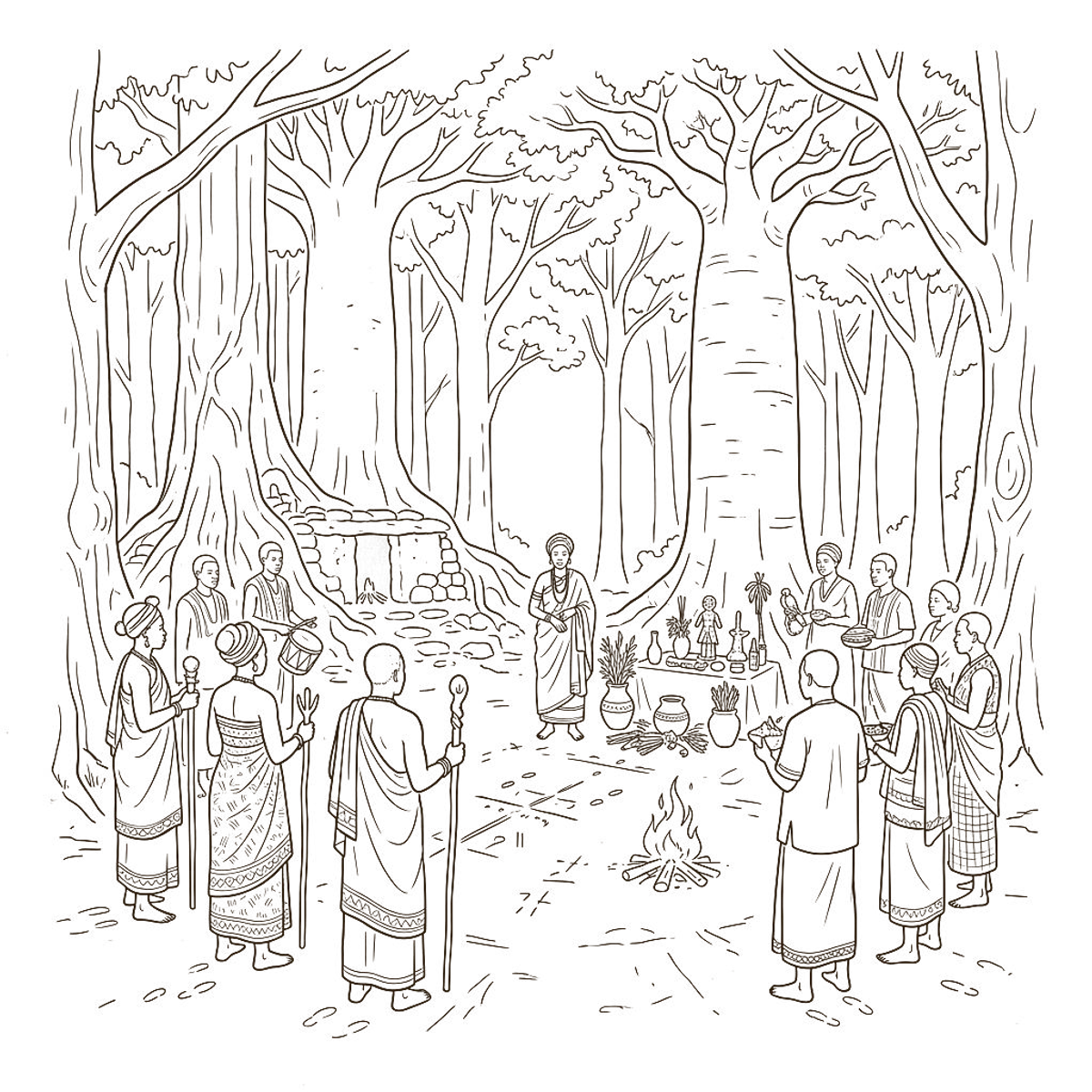
In Aneho, spiritual geography is just as complex and structured as urban geography. Voodoo deities (the "Tohossou" or "Vodou") do not inhabit a distant sky; they cohabit with the living. They reside in precise sacred places: impenetrable forests, centuries-old trees, rivers, crossroads, and closed sanctuaries.
The Geography of the Sacred
To understand Aneho, one must realize that the city is literally built around its altars. Each major neighborhood has its "Agbetowe" (ancestral home) with a temple dedicated to the clan's protective deity (the Akangban). But beyond these familial sanctuaries, there are sacred spaces of royal or pan-community importance.
Sacred Forests (Avezo)
The sacred forest is undoubtedly the most powerful spiritual space in the Guin universe. Unlike a classic state forest, the sacred forest is an inviolable spiritual ecosystem.
Among the most famous is the majestic forest of Glidji, a few kilometers from Aneho, which houses the sanctuary of the Sacred Stone (Kpessou). These woods are governed by strict laws:
- Ban on hunting or cutting wood: Fauna and flora are considered physical manifestations of the deities.
- Restricted access: Non-initiates can only enter during specific ceremonies, and often only up to a certain limit (the outer clearing).
- Silence and respect: It is strictly forbidden to speak loudly, wear certain colors (often red), or enter with shoes on.
Sanctuaries and Convents (Hounkpe)
If the forest is the wild domain of earth and nature deities, the convent (Hounkpe) is the school where one learns to serve them. The urban and peri-urban sanctuaries of Aneho are distinguished by their unique architecture.
The Architecture of a Voodoo Temple
A traditional Voodoo temple is not necessarily an imposing building. It can be a simple round thatched hut, or a courtyard bounded by a woven bamboo fence ("Afa-za"). The central element is not the edifice, but the Assen (metal altar) or the mound of sacred earth ("Legba") that receives libations and offerings.
The sanctuary walls are often painted with esoteric symbols using white lime or red clay, recounting the myths of the resident deity.
The Initiation Site: A Space of Rebirth
Sacred places are above all spaces of transformation. When an individual is "called" by a deity (often following an unexplained illness or sudden possession), they are taken to a convent (the "Hounzo"). They will spend several weeks, or even months there, cut off from the secular world. Within the walls of this sanctuary, the "Voudoussi" (spouse of the god) will learn a secret new language, new songs, and receive a new name, symbolizing their spiritual rebirth.
The Lagoon and Sacred Waters

The lagoon waters, both a vital resource and the sacred domain of aquatic spirits.
As Aneho is a water city, wedged between the Mono River, the Atlantic Ocean, and the lagoon system, bodies of water are themselves sacred entities.
Powerful deities like Mami Wata or Tohossou (royal water spirits) have their sanctuaries on the shores of the lagoon. During severe droughts or to ward off floods, complex ceremonies involving richly decorated canoes are organized on the waters of Zebe or Agbodrafo. Priests ("Tohounon") place floating offerings there to appease the aquatic spirits.
Preservation and Threats
Today, these spiritual ecosystems are doubly threatened. On the one hand, by land pressure and urban sprawl nibbling at the edges of protected forests, and on the other hand, by climate change (coastal erosion, rising sea levels) which sometimes swallows ancient altars located too close to the shore.
Fortunately, traditional priests and kings (Lawson and Adjigo) fiercely protect these places. The sanctuarization of nature by Voodoo proves, ironically, to be one of the most effective ecological conservation methods in the region: no chainsaw ventures into a forest where gods live.